Project Details
sEMG Gesture Decoder 2025
Project Overview
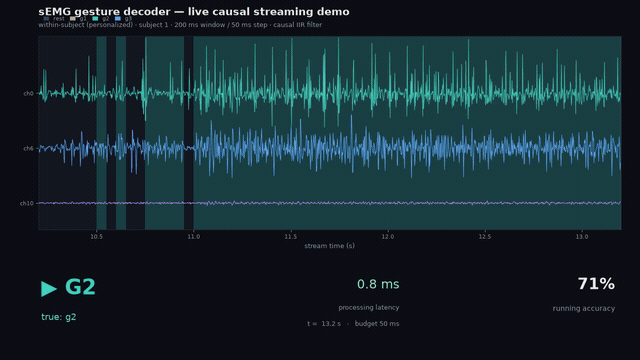
A real-time hand gesture classifier that decodes surface electromyography (sEMG) signals as they arrive, predicting the intended gesture from muscle activity with roughly 1 ms of processing latency per window. The system is built around a causal streaming pipeline, so predictions are produced from only the samples seen so far — the constraint that matters for real-world prosthetic and human–computer interface control.
It trains and evaluates on the public Ninapro DB2 dataset, recorded from a 12-channel Delsys Trigno sensor array sampled at 2 kHz. Models are trained per subject (within-subject / personalized), reflecting how a wearable would be calibrated to an individual user.
Processing Pipeline
Raw signal to prediction
Ingestion:
Loads per-subject Ninapro DB2 .mat files and organizes the 12-channel, 2 kHz EMG stream with its gesture labels.Filtering:
Applies a causal IIR filter that maintains state across windows (scipy sosfilt / lfilter), deliberately avoiding non-causal offline methods like filtfilt that peek at future samples.Windowing & features:
Segments the stream into overlapping windows (200 ms window, 50 ms step) and caches the extracted features for fast, repeatable training runs.Classification:
Feeds features to a trained SVM (RBF kernel) to emit a gesture prediction per window, with per-window latency benchmarked against a 50 ms real-time budget.
Key Features
Real-Time Design
- Causal streaming, no future-sample leakage
- Stateful filtering across windows
- ~1 ms/window, well under a 50 ms budget
- Per-window latency benchmarking
Engineering
- Pure-function core, separate from I/O scripts
- Cached windows/features for fast reruns
- pytest coverage on signal processing
- Live visualization of stream + predictions
Technical Details
Dataset
Ninapro DB2 — surface EMG from a 12-channel Delsys Trigno array at 2 kHz, covering a broad set of hand and wrist gestures. The dataset is not redistributed; the per-subject .mat files are downloaded independently.
Causal vs. Offline Filtering
A central design point is the distinction between non-causal offline processing (filtfilt, which uses future samples for zero-phase filtering) and causal streaming (sosfilt + lfilter with maintained state). Only the causal path is valid for live control, and the pipeline is built to honor that constraint.
Model
Within-subject SVM with an RBF kernel serves as the demonstrated classifier, alongside classical and CNN baselines, trained on cached window features.
Project Information
Signal Processing / Machine Learning
Real-Time Biosignal Decoding
Python, NumPy, SciPy, scikit-learn, pytest
Surface EMG, Causal Streaming, Digital Filtering, SVM / CNN Classification
Results
Latency
Per-window processing runs at roughly 1 ms, comfortably inside the 50 ms real-time budget, leaving ample headroom for live gesture control.
Live Demo
A recorded demo streams filtered EMG channels while overlaying the predicted gesture, the true label, the current processing latency, and a running accuracy counter — validating the causal pipeline end to end on a personalized subject model.